How long does it take to get a skydiving license?

Newly Certified Skydiver at Dropzone Denmark

At Dropzone Denmark, we have seen students take their skydiving licence in as little as 2 weeks, to 2 years or seasons. The time it takes mainly depends on how often you can be at the dropzone when we are open, how the weather develops, and how quickly you become ready for the next step in the training.

Two weeks is therefore possible – we have seen that. But it requires a combination of plenty of time, good skydiving conditions, and a process where things fall into place. It is not a timeline we can guarantee in advance.

Skydiving licence in 2 weeks: What does it require?

Happy skydivers at Dropzone Denmark

The few students who completed their licence in about two weeks with us were at the dropzone every single day we were open. They gave themselves the opportunity to jump when conditions allowed, and the weather cooperated most of the time.

At the same time, they were patient and adaptable when the weather was troublesome. A break in jumping activities did not mean they were done learning for the day.

They stayed at the dropzone and used the time when we were in what we call a "weather hold," where we wait for better weather, to:

  • Learn more about the theory.
  • Learn to pack their parachute.
  • Prepare for the next jump.
  • Ask questions and work further with feedback from instructors and other skydivers.

If you want to quickly progress towards your skydiving licence, it is therefore an advantage to set aside the time and be prepared for the day's program to change. Check our opening hours, and assume that you should not make any other plans than skydiving in the 4 weeks after you start the course. That way, you'll achieve your licence quite quickly.

How can a skydiving license take two seasons?

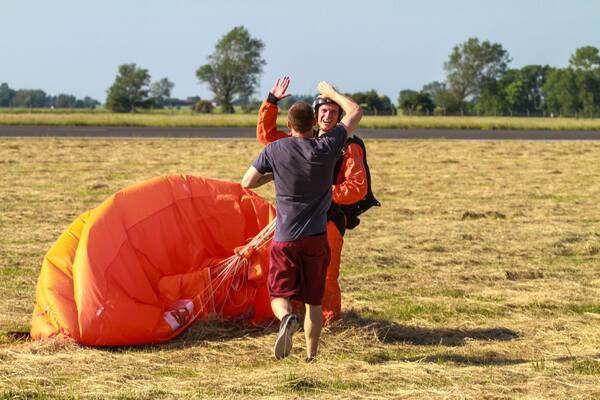
highfive after skydive

As described before, how quickly you get through your skydive training depends on a combination of the weather, your adaptability, and how quickly you learn the procedures and skills you need to be able to perform. However, our experience is that the biggest factor is often how much time you have actually set aside for the education and training.

A skdyving course must, of course, fit into your everyday life. If you can only make it for a single day every now and then, or a few weekends, the process will naturally take longer. 

The weather is also a factor. You may have time off and be ready to jump, but the conditions may not be suitable for student jumps. Other days there are good opportunities to progress, and here you may not have the chance to be at the dropzone.

Finally, we learn differently. Some exercises come together quickly, while others require more attempts. An AFF level may therefore need to be repeated before you move on to the next one. And that happens for almost every student.

When we say from two weeks to two seasons, we are describing the variation we have seen among our students. It is neither a fixed deadline nor a promise that everyone can finish in the shortest time

Skydiver in a week - is definately a course programme for you who wants quick progression

Tea Terkelsen, Head of Student Activities at Dropzone Denmark

If you want to prioritise your skydiving education and create good opportunities for quick progression, Skydiver in a Week is an ideal start.

Here, you set aside at least 5 consecutive days, from morning till evening, to learn how to skydive. This way, you can focus on the training without having to fit work and other everyday commitments in between jumps. On the days we have scheduled the skydiver in a week course, we also have extra AFF instructors working, and higher student priority, to give you a better chance of quickly completing the instructor-heavy jumps.

The course is a cohesive AFF program, where we combine theory, practical training, jumps, and instructor support. You start with thorough instruction and physical exercises, so you are prepared for both your first skydive and the procedures you need to learn to perform.

How far can you get in a week?

The goal is to complete the AFF portion of the training, when the weather and your progression allow it.

Skydiver in a week is therefore not a promise of a full skydiving license in just a few days. It is an intensive start, where you work purposefully on the foundation for the rest of the training.

After the AFF portion, you continue towards your USPA A-license. If you want to maintain the quick progression, we recommend that you also prioritise time at the drop zone in the weeks following the course. Consider the course week as the beginning of an entire month, where you use as much of your free time as possible on the training.

How to get the best start on your skydiving journey

Be flexible and use your time on the ground actively.

If you want quick progression, we recommend prioritising using all your free time for the course for at least one full month and attending as much as possible on our opening days. At the same time, it requires patience and adaptability, because both the weather and your learning pace affect how quickly you progress. Therefore, use the waiting time on the ground on theory, parachute packing, and preparation as well.

Leave the ego at the door and allow yourself to be "just a student".

You don't need to be the one who finishes the quickest. The goal is for you to learn what you need and build a good foundation to continue in the sport. 

Skydiver in a week gives you an intensive start

The course gives you a quick and effective start to your skydiving training. The full USPA A-license requires at least 25 jumps, fulfilled skill requirements, and a passed exam. The goal is to acquire the knowledge and practical skills that prepare you to continue as an independent skydiver.

Frequently asked questions

Is it possible to get a skydiving licence in two weeks?

Yes, we have experienced it at Dropzone Denmark that a few students have started a skydiving course and 2 weeks later have a USPA-A license. The students in question were at the dropzone every day we were open, had favourable weather conditions, and also used their breaks for learning. It is a possibility, but not a guaranteed completion time. We recommend that you set aside all your free time for at least 4 weeks to complete a skydiving license course.

Why can a skydiving licence take two seasons?

If you come less frequently, experience cancellations due to the weather, or need a lot of extra training, the process will naturally take longer.

Work, everyday life, holidays, and other plans can also mean that the training is spread over two seasons.

Do I get a full skydiving licence with the course, Skydiver in a week?

No. The week course focuses on the AFF part and gives you an intensive start. After that, you will continue towards the full licence. How far you get during the course week depends on the weather and your progress.

What can I do as a student when the weather prevents skydiving?

You can among other things:

  •  work with skydive theory
  • prepare for the next jump
  • learn to pack the parachute
  • talk to and learn from other skydivers

Time on the ground can thus also advance you in your education.

Should I complete the skydive education as quickly as possible?

You don't need to rush, but we recommend that you work purposefully towards your skydiving license and prioritize a coherent progression without long breaks between jumps.

When you jump regularly, you can build on your experiences and use the instructors' feedback while both the learning and the movements are still fresh in your memory. If there is a long time between your AFF levels or jumps, you may need to refresh procedures and regain your comfort before you are ready to move on. It can feel like taking a few steps back and only one forward every time you return.

The most important thing is still to get the skills properly in place. But by setting aside time and showing up often, you give yourself a better opportunity for stable progression, where each jump builds on what you have already learned.

Kristín Anný Walsh
Marketing, sales and event manager

Kristín Anný Walsh is not an experienced skydiver as she has only done one tandem jump. However, she was hired at Dropzone Denmark in 2024 to improve and streamline communication on various platforms, as well as the company's marketing and sales efforts, and keep track of the many different annual events.

She brings a unique perspective to the management team as she brings with her the experience of being new to the sport.